

Nvidia expands local AI agents across RTX & DGX PCs
Tue, 2nd Jun 2026
Nvidia has introduced RTX Spark PCs and expanded support for local AI agents across its RTX and DGX systems. Microsoft, Adobe, Blender and several agent developers are part of the broader rollout.
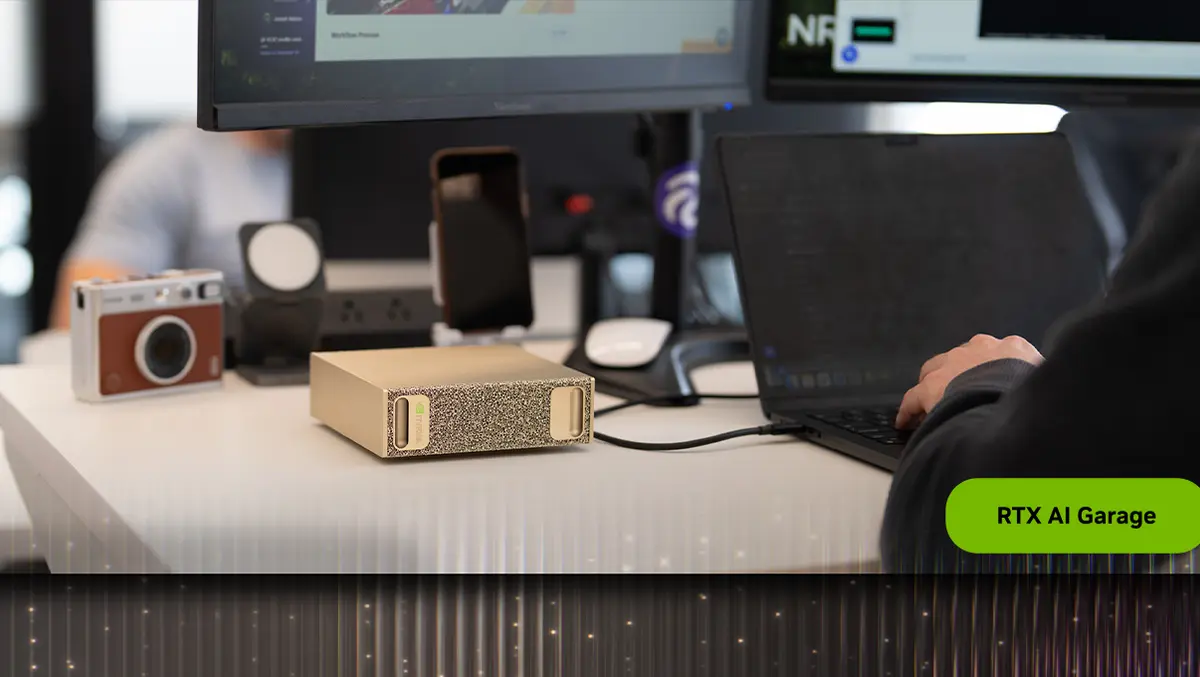
The announcement focuses on a new category of Windows PCs designed to run personal AI agents on the device rather than in the cloud. RTX Spark systems will ship with up to 1 petaflop of AI compute and 128GB of unified memory. A separate DGX Station for Windows is aimed at professional users who want desktop systems with higher-end inference hardware.
Local AI agents have drawn growing interest from developers because they can work across applications, automate repetitive tasks and manage multi-step workflows while keeping data on the user's machine. Nvidia and Microsoft are framing that model around privacy and user control, saying wider adoption has been limited by the difficulty of running such software securely on a primary PC.
Windows security
To address that, OpenShell is coming to Windows and will use Microsoft's new security primitives for agents. The runtime is designed to help developers deploy on-device agents with controls over what they can access and do, while allowing requests to be routed between local and cloud models based on privacy settings.
Hermes Agent and OpenClaw are among the first developers set to integrate OpenShell and Microsoft's security features into Windows applications. Those applications will let users run agents that can handle tasks in Windows software, search local files, generate images and video, and work across multiple programs.
Nvidia is also extending its NemoClaw blueprint across GeForce RTX, RTX Pro, RTX Spark, DGX Spark and DGX Station systems. New installers are intended to simplify deployment on Linux and Windows Subsystem for Linux, with automatic sandboxing and support for Hermes Agent.
Performance push
Nvidia used the launch to highlight work with open-source AI software communities. It said work with the llama.cpp project on multi-token prediction and other optimisations doubles inference performance on some agentic models, including Qwen 3.6 and 3.5 27B, and improves performance by 1.6 times on Qwen 3.6 and 3.5 35B.
Nvidia also said llama.cpp now adds tensor parallelism for multi-GPU systems, giving users with two equivalent GPUs up to 2x memory and 1.8x compute. ComfyUI, another widely used tool for local generative AI workflows, is getting a new classifier-free guidance method for up to 2x performance on two equivalent GPUs, along with the option to split model chains across graphics processors.
For Linux users, Nvidia said it has collaborated with vLLM to improve inference on DGX Spark. According to the company, those changes deliver 2.6x performance on DGX Spark compared with previously available NVFP4 checkpoints from Unsloth for Qwen 3.6 35B.
Creative software
The launch also includes a push into creative applications. Adobe is reworking Photoshop and Premiere for RTX Spark, using unified memory, Blackwell GPU architecture and TensorRT to improve editing, colour correction, compositing and AI-assisted features, according to Nvidia.
Premiere is due to receive a new video pipeline intended to improve handling of complex timelines and support real-time editing and colour correction. Photoshop is being rebuilt around a new engine for GPU-accelerated compositing, live filters, high dynamic range work and digital brushing.
Adobe will also extend Premiere and Photoshop so users can work with Windows agents inside those applications, Nvidia said. Substance 3D Painter and Stager are also set to run natively on RTX Spark.
Blender is adding DLSS 4.5 Ray Reconstruction in Cycles as a denoiser, a change Nvidia said will turn the path-tracing viewport into an interactive real-time viewer with near-final image quality. Nvidia is also introducing RTX Video Frame Generation, which is intended to double or quadruple video frame rates in real time and will be offered as a Python wheel and a ComfyUI node.
Wider ecosystem
Outside content creation, H Company is releasing computer-use tools, including new models and a desktop agent harness, tuned for RTX and DGX PCs, according to Nvidia. The harness lets agents navigate a PC by interpreting the screen and controlling mouse and keyboard inputs, including in software without application programming interfaces.
Nvidia said it has worked with H Company to quantise Holo Computer Use models and speed up the harness, producing a 2x speed increase on Nvidia GPUs while cutting memory use by 35%.
Other updates include Nvidia Broadcast 2.2 and Project G-Assist. Broadcast 2.2 moves Studio Voice out of beta, extends support to GeForce RTX 3060 GPUs and above, and adds Elgato Stream Deck integration and configurable keyboard shortcuts. Project G-Assist is also gaining Stream Deck support through the Elgato MCP Server.
In outlining the strategy behind the launch, Nvidia said local AI agents need both secure software controls and hardware built for inference at the edge. The push spans consumer PCs, developer systems and creative applications, with much of the software arriving alongside RTX Spark later this year and some tools already rolling out.