

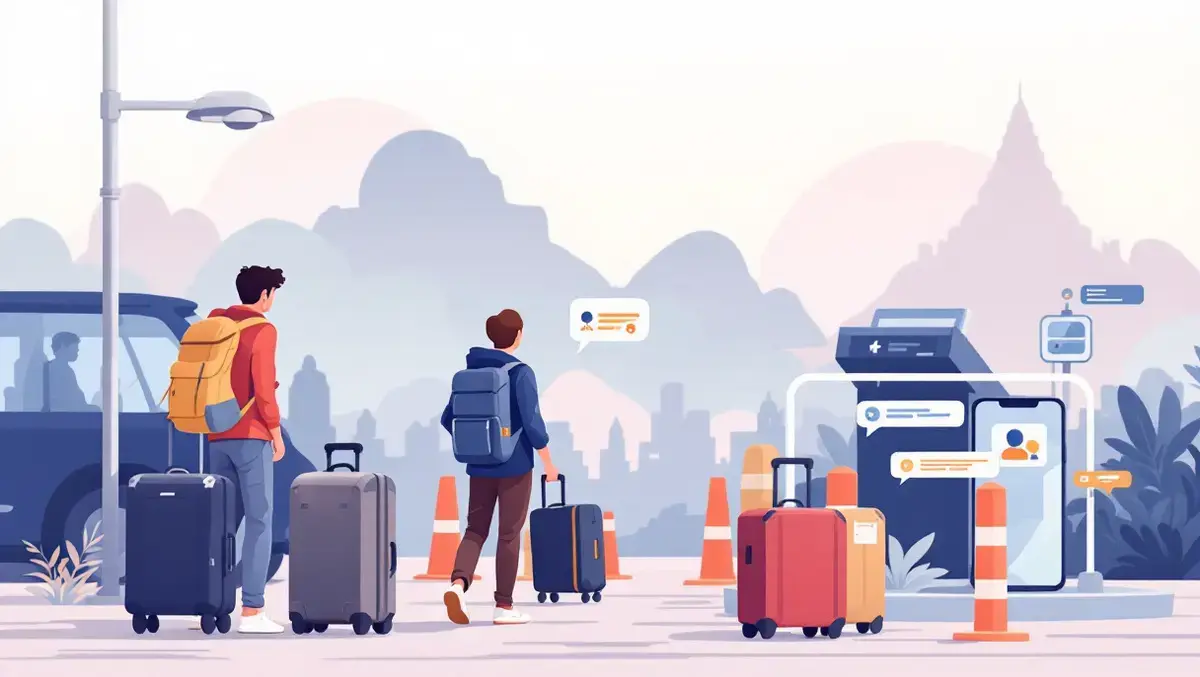
iVisa warns travellers over AI visa advice after border snag
Wed, 27th May 2026.webp)
iVisa has warned travellers not to rely on general-purpose AI chatbots for visa advice after an incident involving a solo traveller at the Vietnam-Cambodia border.
Rita Santos was stranded at a remote land crossing after a chatbot told her she could obtain a visa on arrival there. Border officials would not issue the document for her nationality, forcing her to seek urgent help from a third-party agency.
Santos, who is travelling solo with the aim of visiting every country in the world, said the mistake resulted in a USD $250 emergency fee and hours of waiting in 40°C heat. She said she was left without support at the crossing and came close to fainting.
Her case comes as more travellers use AI tools to organise trips. A February 2025 Kantar survey of more than 10,000 consumers across 10 countries found that 40% of global travellers have already used AI to plan travel, while 62% said they would consider doing so in future.
Border risks
Visa research remains poorly suited to large language models, according to iVisa, because immigration rules can change quickly, vary by point of entry, and often require case-specific interpretation. The company argued that airport and land border rules are often different, but chatbots can blur that distinction.
That can have direct consequences when travellers act on inaccurate information. Unlike a specialist provider or an official source, a general AI tool offers no assistance after an error and does not compensate users for losses.
"Wrong information at the wrong moment has a real cost," said Santos.
"I wasn't just dealing with a logistical nightmare, I was in survival mode. You need a tool you can actually trust when you are at your most vulnerable."
iVisa said many AI models rely on historical training data rather than live immigration records. Even when a chatbot gives a confident answer, it may reflect rules that have changed or do not apply to a specific nationality or crossing point.
Human checks
Victor Gimenez, Director of Customer Experience at iVisa, said travel documentation requires current information and direct verification.
"Travel is about freedom, but that freedom rests on the foundation of accurate legal documentation," he said.
"We don't guess; we verify. Our platform combines cutting-edge technology with a global team of experts who monitor government updates in real time."
iVisa said specialist visa services and government immigration portals are better placed to provide up-to-date information because they track policy changes as they happen. Travellers should check rules close to departure, review requirements for their exact nationality and route, and treat chatbot answers only as a starting point.
In practice, that means checking whether an entry rule applies at an airport, land border, or seaport, and whether it differs by passport type. Such details are often decisive in determining whether a traveller can cross a border, but they can be lost in general responses generated by consumer AI tools.
The warning highlights a wider issue for the travel sector as AI becomes a common planning aid. Travel businesses, immigration advisers, and border support specialists are grappling with how to respond to tools that give quick answers to regulated questions without clear sourcing or responsibility for mistakes.
For travellers, the appeal is obvious: AI systems can summarise destinations, routes, and requirements in seconds. But Santos's experience shows how a single incorrect answer on a regulated issue can quickly turn a trip disruption into a personal safety problem.
At remote crossings, where help desks and alternative options may be limited, that risk can rise sharply. The difference between an airport with airline staff and a land checkpoint with little support can leave travellers exposed if they arrive without the right paperwork.
iVisa said the safest approach is to cross-check any AI-generated visa guidance against official government sources or a verified specialist platform before travelling.