


Google Cloud expands Gemini Enterprise into AI agent hub
Thu, 23rd Apr 2026
Google Cloud has expanded Gemini Enterprise into a unified platform for building, running and governing AI agents. The move brings together developer tools, an employee-facing app and a marketplace for third-party agents.
The updated Gemini Enterprise combines Google Cloud's Agent Platform, the Gemini Enterprise app and an open partner ecosystem in a single system for businesses managing large numbers of AI agents across teams.
Agent Platform replaces and extends Vertex AI as Google Cloud's main environment for agent development. It is intended for developers and IT teams to build, tune, deploy and monitor agents that can carry out multi-step business processes, while applying central controls for identity, security and auditing.
The platform includes an updated Agent Development Kit with a graph-based framework that supports networks of sub-agents and connections to external systems through integrations and support for MCP. Google Cloud has also updated its runtime layer with agent-to-agent orchestration and memory features designed to retain user preferences and prior context across sessions.
Governance is a central theme of the rollout. As businesses begin to build and manage thousands of agents, stronger oversight is becoming necessary as AI tools spread across departments. New features include Agent Identity, which assigns each agent a cryptographic identifier, and Agent Gateway, which manages interactions between agents and data sources.
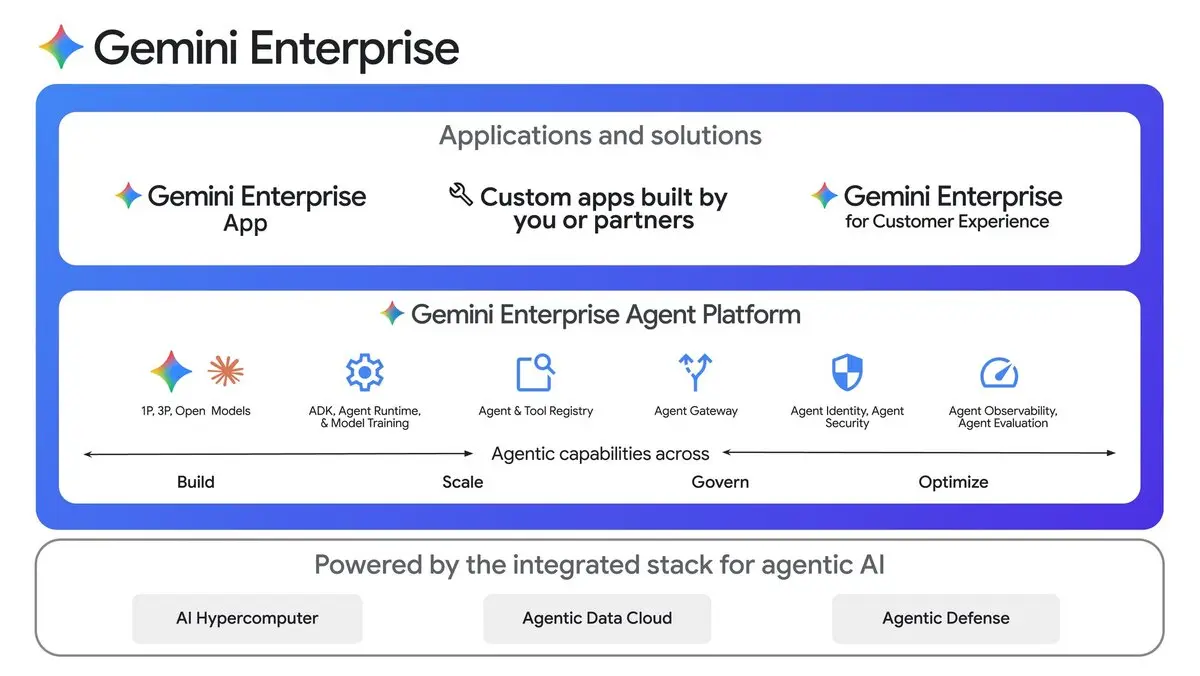
Model Armour is also included. It is designed to protect against prompt injection, tool poisoning and the leakage of sensitive data.
Employee Access
Alongside the developer platform, Google Cloud is positioning the Gemini Enterprise app as the main entry point for everyday employee use. The app lets staff find, create, share and run agents in one interface, with data governance, identity and compliance controls inherited from the underlying platform.
The company has also added a no-code tool called Agent Designer, which allows users to create agents using natural language. These agents can be set to run on schedules, respond to triggers from other business applications or use partner connectors to work with external systems.
A feature called Inbox in Gemini Enterprise gives users a central place to monitor long-running agents and receive status alerts through email and chat. Google Cloud also introduced Projects, a shared workspace designed to preserve context and history for teams working with agents on ongoing tasks.
Canvas, another new element in the app, provides an editor for collaborative work in Google Docs and Slides. Google Cloud has added Microsoft 365 interoperability so files created in Canvas can be exported in common Microsoft Office formats.
Partner Agents
Google Cloud is also trying to expand Gemini Enterprise beyond software developed in-house. Partner-built agents from Google Cloud Marketplace are being brought directly into the app's Agent Gallery, allowing employees to discover and request third-party tools within the same workflow.
Oracle, Salesforce and ServiceNow are among the companies involved in the broader ecosystem. Google Cloud also cited Adobe, Salesforce, ServiceNow and Workday as examples of partners whose agents can be used through the Gemini Enterprise app. According to the company, these third-party agents have been validated for security and interoperability requirements.
The strategy reflects a wider industry shift as large technology companies compete to offer end-to-end AI systems for enterprises rather than standalone models or chat assistants. Vendors are increasingly focusing on orchestration, security and administrative control as companies move from experimentation to production use of AI tools in finance, operations, support and internal knowledge work.
Google Cloud said the aim is to give developers, IT departments and knowledge workers a common environment rather than separate tools for model access, app development and oversight. For IT teams, that means a single control plane for identity, security and auditing across both no-code and pro-code agents. For developers, it means access to models, tuning services and orchestration tools in one place.
"Today, we're enhancing our most powerful AI tools and bringing them together under one roof," said Brian Delahunty, vice president of engineering for Agents Platform at Google Cloud, and Michael Gerstenhaber, vice president of product management for Cloud AI at Google Cloud.