

From Clipboard to Cloud: Why manual temperature checks are a food safety gap of the past
Wed, 16th Sep 2026 (Today)
Here's a question for Quality Managers working in food retail businesses. If a critical temperature fluctuation had occurred in a store's frozen seafood cabinet at 2 am last Tuesday, would you know? Or could you instantly look across all chilled dairy products and see which refrigerators have had the most out-of-range temperature events in the past 6 weeks?
For some companies, that question could only be answered after digging through a week's worth of temperature logs.
More often than not, it's the lack of easy-to-access data and timely insights that prevents quality teams from implementing more proactive measures to reduce food wastage, foodborne illness risk, and regulatory exposure.
At AoFrio, we've spent considerable time talking to food retail operators about how they manage food safety inside of their chilled and frozen retail assets, and the picture that emerges is surprisingly consistent regardless of store size or geography.
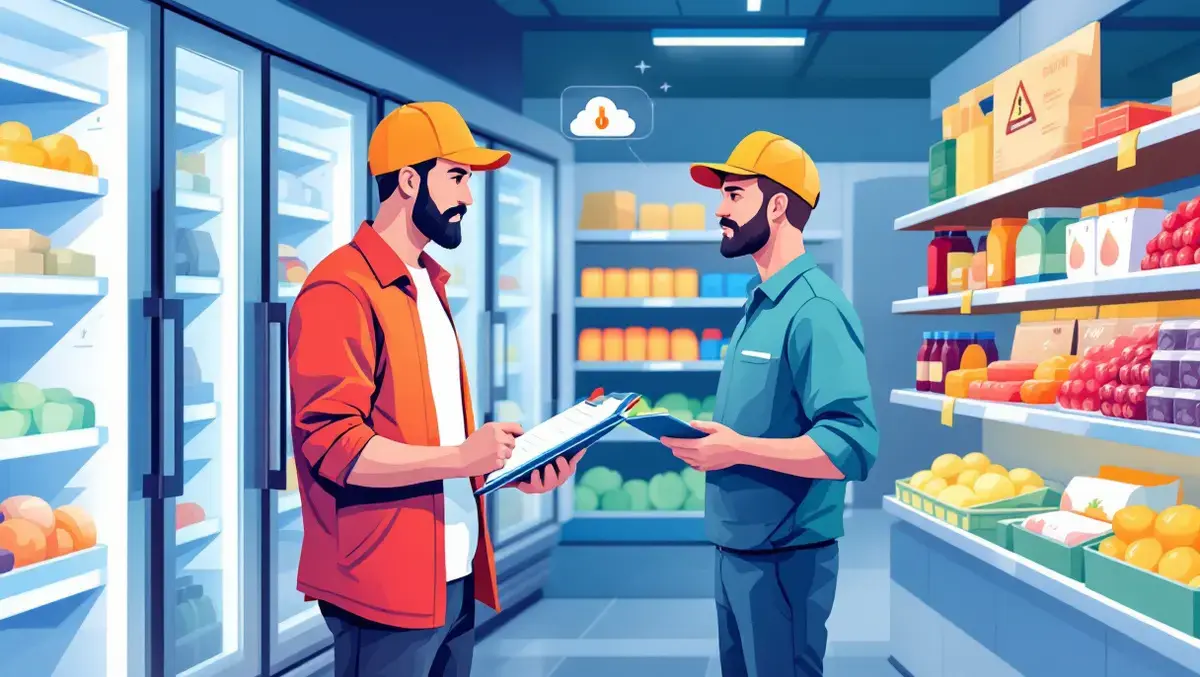
Most sites still rely on staff conducting manual temperature checks two or three times a day. Someone walks the floor with a clipboard, records the readings, and files the log periodically throughout the day. That data is then compiled after the fact in a system somewhere, which can comprise anything from a spreadsheet to a basic portal.
Technically, it's a system that enables compliance with HACCP's monitoring and record-keeping principles, but it leaves a lot to chance and human error. You're dependent on busy customer service teams having the discipline to log temperatures, whilst also relying on periodic data rather than always on proactive monitoring. For quality teams, it means any attempt to improve food safety culture can only take place days or even weeks after an actual incident.
Our own 2023 research across food retail operators globally found that only 35% of sites monitor food storage temperature on an hourly basis. That means nearly two-thirds of retailers have significant blind spots in their cold chain visibility. In chilled and frozen food categories, where margin is thin and spoilage is fast, that can carry real financial consequences.
The cost of not knowing
Our research found that temperature fluctuations and a lack of early warning alerts contribute to an estimated US$3,500 in food waste loss per site per month. That's before accounting for the harder-to-quantify costs, like employee time spent on manual logging or the reactive scramble when a unit fails.
And then there's the reputational damage if a food safety incident is traced back to inadequate temperature management. There are few incidents that harm customer trust to the extent that a major health incident can.
The USDA's Economic Research Service puts the total cost of foodborne illness in the United States alone at $74.7 billion annually. Equipment malfunction and inadequate cold storage are named explicitly in their food loss taxonomy as contributing causes at the retail level. HACCP exists precisely to prevent these failure points, yet its effectiveness depends entirely on the quality of monitoring data behind it. Unfortunately, these systemic failure points have largely been absorbed by the industry as just the cost of doing business.
The maintenance problem nobody talks about
Temperature excursions don't only happen because of poor monitoring practices. A significant proportion happen because refrigeration assets fail. Our research found that 46% of service calls only occur after a unit has already stopped working completely. By that point, the damage is done.
This is a pattern we heard repeatedly from food retailers when we were developing our IoT and software monitoring solution. Maintenance teams are stretched, service contractors are reactive by default, and there's rarely a system in place to flag that a unit is struggling before it gives up entirely. A compressor running harder than it should, a condenser gradually losing efficiency, a door seal that's been letting warm air in for weeks; these are all detectable early warning signs that a manual inspection will almost certainly miss.
AoFrio iQ for Food Retail monitors for anomalies in cooler performance that can signal an asset is heading toward failure. When something looks irregular, the relevant person gets an alert, whether that's an in-house facilities team or a third-party service contractor.
The app works on iOS and Android and requires nothing more than an email address to onboard a technician, so getting the right people into the loop is straightforward regardless of how maintenance is structured.
Building a culture, not a paper trail
With AoFrio iQ for Food Retail, we set out to change how temperature data gets collected in the first place, not just make the clipboard digital.
What food retailers need is continuous, automated intelligence that surfaces the right information to the right person at the right time, without relying on human intervention.
In practice, that means sensors in every refrigerated unit feeding live data into a cloud dashboard, with configurable alerts that notify Quality Managers the moment a temperature moves outside the acceptable range. It means store teams spending less time on reporting and more time on the floor with customers. And it means the maintenance team that gets an early warning about a compressor showing signs of stress, rather than a call at 6 am to say the unit is down and the stock is warm.
One of our early retail partners put it well when they described the shift from manual to real-time monitoring as moving from reactive to proactive. That captures the intention behind AoFrio iQ; to build a better operational outcome for retailers who take food safety seriously.
With AoFrio iQ, the technology to close the cold chain visibility gap exists. Finally, food retailers can put the clipboard back into the drawer and move to a smarter way to bolster food safety culture.