

.webp)
Creality has launched the Pika portable 3D scanner with Orbbec and expanded its strategic partnership with the company.
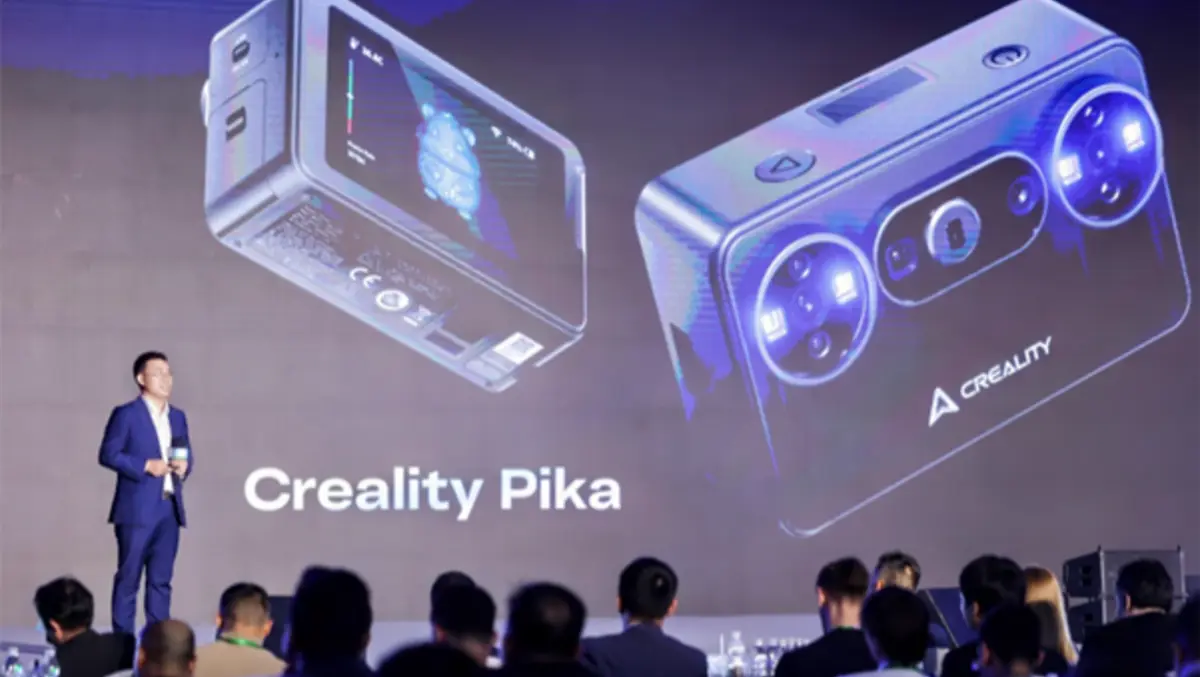
Designed to work directly with a smartphone rather than a PC, the device weighs 260g. Creality unveiled the scanner during its anniversary product launch event, where the companies also outlined plans for a joint innovation centre focused on 3D scanners and a next-generation AI vision system for 3D printing.
Pika is aimed at users who want to capture 3D models away from fixed desktop setups. It measures 100 x 60 x 35 mm and includes a built-in HD display for live scanning previews, along with a replaceable battery for mobile use.
A key part of the launch is the scanner's ability to run in different modes depending on the hardware it is connected to. In smartphone mode, line-laser scanning supports up to 40 frames per second, while infrared mode reaches up to 20 frames per second. When linked to a PC, line-laser scanning can reach up to 110 frames per second.
Orbbec's technology underpins the scanner's imaging system. The product uses a global shutter 3D camera architecture designed to reduce motion blur during handheld use and help maintain tracking while the operator is moving.
Broader push
The scanner combines 7-line blue laser scanning and infrared structured light in a single unit. The companies said the blue laser system can achieve scanning accuracy of up to 0.03 mm, making it suitable for smaller objects and items with fine detail, while the infrared mode is intended for larger subjects such as people and bigger objects.
The product is positioned for a wide range of users, from hobbyists to engineers and designers. It can be used for tasks including object scanning, full-body capture and structural modelling, with AI-based processing intended to simplify workflows for less experienced users.
Among the software tools included is an AI body completion function for portrait 3D printing. The companies said the feature can generate complete printable models with little or no manual editing, reducing the amount of post-processing often required after a scan.
The launch also reflects a broader commercial relationship between the two businesses. Since entering a partnership in 2023, Orbbec and Creality have worked together on several products linked to 3D scanning and manufacturing, with Orbbec contributing imaging and vision technology.
Creality has built its business around consumer 3D printing and related hardware, including scanners and laser engravers. Orbbec focuses on robotics and AI vision and says it serves more than 3,000 clients and developers across nearly 100 countries and regions.
The expanded partnership adds a more formal research element to that relationship. The planned "3D Scanner Digital Joint Innovation Centre" suggests the companies want to deepen development work around scanning tools, while the proposed AI vision platform points to closer integration between imaging, software and 3D printing workflows.
The announcement came as Creality made its debut on the Hong Kong Stock Exchange, adding a capital markets backdrop to the product launch and partnership expansion. Together, those moves suggest the company is looking to broaden its position in digital manufacturing tools beyond printers alone.
Portable 3D scanning remains a relatively specialised segment compared with desktop 3D printers, partly because of the cost and complexity of balancing mobility, precision and processing power. By shifting more of that process to a smartphone-connected device, Creality and Orbbec appear to be targeting a broader market that includes creators and small businesses working outside studio or factory environments.
Competition in the market has increasingly centred on ease of use as much as technical performance. Smaller devices, app-based workflows and automated processing have become more important as manufacturers try to attract users without specialist training in scanning or modelling.
For Orbbec, the product is another example of how its imaging systems can be embedded in devices sold under a partner's brand. For Creality, it adds a more portable scanning option to a portfolio already closely tied to 3D model creation and printing.
The companies said Pika was developed to bring 3D scanning into more routine creative and production work through a pocket-sized format and direct smartphone operation.