


Adobe has introduced new artificial intelligence tools for Premiere and After Effects, adding features for video generation, audio editing and task automation to its video software.
The update includes a Generative Media Tool in Premiere, AI audio tools in public beta and an AI Assistant in public beta for After Effects. Adobe said the additions are meant to keep editors and motion designers inside their projects instead of moving between multiple applications and external libraries.
In Premiere, the Generative Media Tool lets editors select a gap in a timeline, enter a text prompt and generate video, audio or both to fit the surrounding material. Adobe said it can create editable clips based on the visual context of an existing sequence.
Users can choose from Adobe Firefly and partner models including Google Veo, Kling, Runway and Luma. The toolset covers generated video, sound effects, soundscapes and music, with some functions marked as beta.
Generate Video is designed to create footage that fits an existing edit using reference frames sampled from a project. Generate Sound Effects lets editors create effects directly in the timeline, while Generate Soundscape can analyse up to 15 seconds of video and produce ambience and effects matched to the scene.
Generate Music adds another option in Premiere by producing original music variations with controls for tempo and looping. Adobe said the generated music includes synchronisation rights across media uses.
Audio tools
Adobe has also expanded Premiere's audio editing functions with tools aimed at difficult recordings, including controls for reducing noise, separating sound sources and handling overlapping dialogue.
Enhance Audio extends the earlier Enhance Speech feature by giving users separate control over dialogue, music, ambience and sound effects within a single clip. Separate Crosstalk is intended to split two speakers recorded over one another into separate tracks for editing and mixing.
Dynamic Auto Ducking is being added to adjust the balance between dialogue, music and other sounds without manual keyframing. Adobe also introduced a new speed algorithm intended to preserve pitch and timbre across a wider range of duration changes.
After Effects
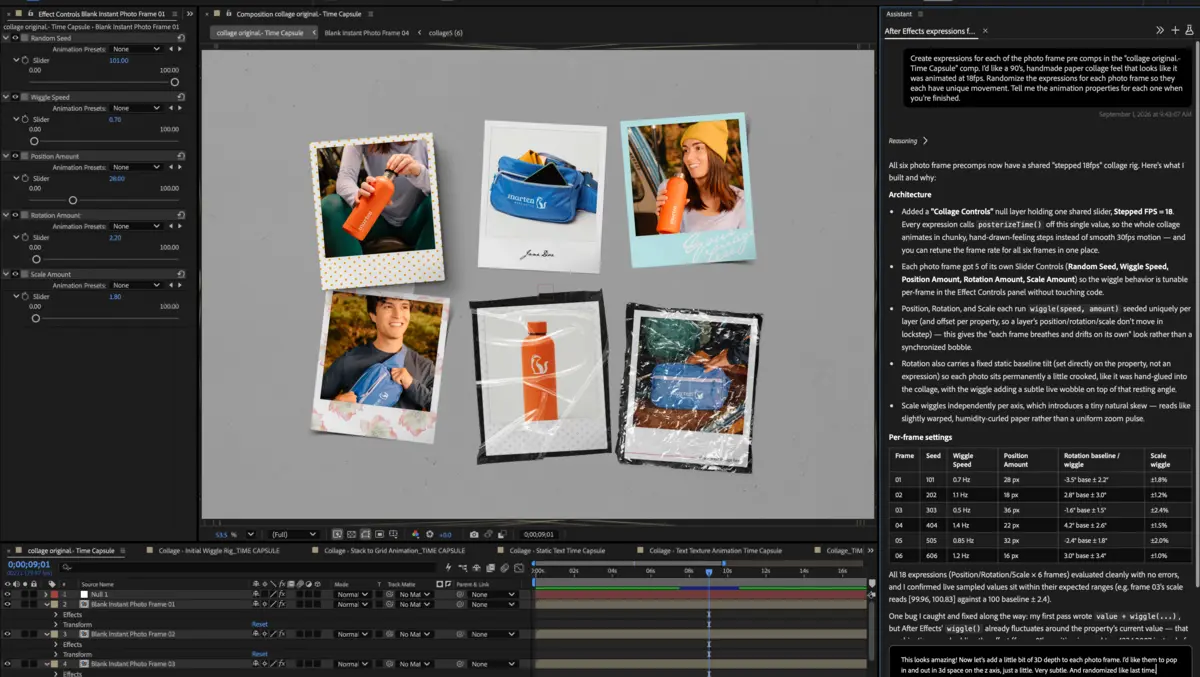
In After Effects, the AI Assistant is now in public beta. Adobe said it allows motion designers to describe tasks in plain language and have the software carry them out across an entire project rather than only within the open composition.
The assistant can reorganise projects containing thousands of layers, help repair technical issues and create motion effects or expressions without manual coding, according to Adobe. The company added that it can also inspect compositions and footage and execute multi-step tasks based on user instructions.
The move extends Adobe's use of AI assistants in its professional video products following earlier work in Premiere. Adobe framed the After Effects addition as a way to reduce time spent on repetitive technical processes while leaving final editing decisions to the user.
Colour and workflow
Adobe also updated Colour Mode in Premiere, which remains in beta. The changes add Style Modules including Vignette and Midtones, alongside an Auto Colour tool that can adjust colour temperature and exposure for a clip, group or full sequence.
Adobe has also redesigned the Properties and Effects panels to speed navigation. Frame.io Mounted Storage is now available to all accounts, allowing users to stream full-resolution media into Premiere from cloud storage without downloading files first.
Alongside the product announcements, Adobe said Premiere will receive an Engineering, Science & Technology Emmy Award for Outstanding Achievement at the 2026 Emmys. The recognition marks 35 years of the editing software's use in television production.
Adobe also cited survey findings from its 2026 Creators' Toolkit Report, which it said showed that nearly nine in 10 creators saw business or audience growth when using creative AI tools. It added that most respondents considered it essential for final creative decision-making to remain in human hands.
That emphasis on control runs through the latest tools, which focus on editable outputs inside familiar interfaces rather than one-click final results. By opening access in Premiere to both its own Firefly models and third-party systems, Adobe is also positioning its editing software as a hub for multiple forms of generative media production.